China-Linked StormEncryptor Ransomware: What State and Local Agencies Need to Know
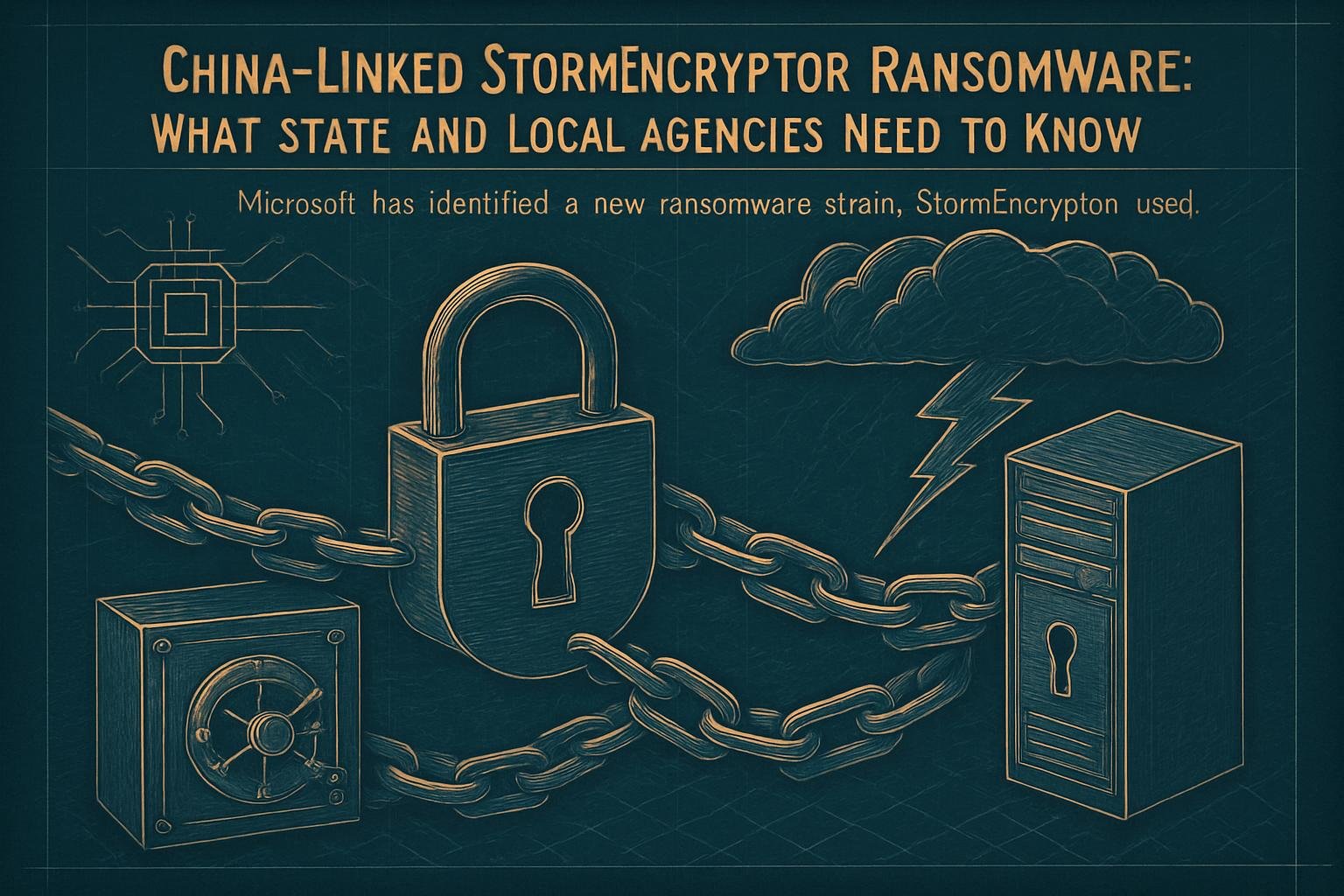
Microsoft has identified a new ransomware strain, StormEncryptor, used by a financially motivated threat actor it tracks as Storm-1175, assessed to be China-linked. This group was previously associated with the Medusa ransomware family but has shifted to a new toolset. While the activity is still being analyzed, the tactics highlight important lessons for state and local governments, school districts, public utilities, and community-serving organizations working to secure their operational and citizen-facing systems.
This article explains what is currently known about StormEncryptor, the likely exploitation of remote monitoring and management (RMM) tools like N-central, and how public-sector teams can use this information to strengthen cyber defense, security operations, and incident response around their digital services.
Key Takeaways
- New ransomware family: Microsoft has disclosed a previously undocumented ransomware strain named StormEncryptor, deployed by a financially motivated group tracked as Storm-1175.
- China-linked actor: Storm-1175 is assessed as a China-linked threat actor with a focus on monetization, not just espionage.
- Tooling shift: The group appears to have transitioned from using Medusa ransomware to its own C++-based StormEncryptor payload, which appends the
.encryptedextension to files. - Likely RMM abuse: The campaign is suspected of leveraging a vulnerability or misconfiguration in N-central or similar remote monitoring and management platforms to gain access and deploy ransomware.
- Public-sector relevance: Agencies and districts that rely on managed service providers (MSPs), remote tools, or centralized IT management platforms should treat RMM hardening and vendor governance as core parts of cyber resilience.
- Actionable response: Security teams should integrate RMM-focused controls, ransomware-ready backups, and tested incident-response playbooks into broader security operations supporting websites, resident portals, and internal systems.
Who Is Storm-1175 and Why Does It Matter to Public Agencies?
Microsoft’s Threat Intelligence team tracks Storm-1175 as a financially motivated threat actor with links to China. Unlike many China-nexus groups that focus primarily on long-term espionage or data theft, Storm-1175 appears to emphasize direct revenue through ransomware operations.
For state and local agencies, school districts, and quasi-governmental organizations, this matters for two reasons:
- Expanded threat profile: China-linked activity cannot be assumed to be limited to intelligence collection. Financially driven ransomware campaigns can just as easily target public-sector networks as private enterprises.
- Shared infrastructure and vendors: Many public entities rely on the same commercial software and managed service providers as private sector organizations. A vulnerability exploited at scale can quickly cross sector boundaries.
Storm-1175’s adoption of StormEncryptor demonstrates that these groups are capable of rapid tooling changes—a direct challenge to static, “checklist-only” security programs. Public organizations benefit from modernized operations that assume adversaries will continuously update their methods.
What Is StormEncryptor Ransomware?
Microsoft reports that StormEncryptor is:
- Written in C++: Indicating a compiled, performance-focused payload that can be adapted across environments.
- File-encrypting: Designed to encrypt victim files and append the
.encryptedextension to affected data. - A replacement for Medusa: Signaling a deliberate shift away from prior ransomware tooling, likely to evade detection or gain operational flexibility.
While technical details continue to emerge, StormEncryptor behaves like conventional ransomware from an operations standpoint:
- Disrupts access to critical systems and information.
- Applies pressure through file encryption and potential data theft.
- Targets environments where downtime has high impact—such as public websites, resident service portals, financial systems, and learning platforms.
For public-sector leaders, the exact ransomware family often matters less than how it enters the environment and whether operational and continuity plans are ready when it does.
Probable Initial Access: Remote Monitoring and Management (RMM) Abuse
StormEncryptor campaigns are suspected of leveraging a vulnerability or weakness in remote monitoring and management (RMM) tools, possibly including N-central. RMM platforms are widely used by IT departments and managed service providers to administer servers, endpoints, and applications at scale.
This pattern is consistent with broader ransomware operations:
- Attackers gain privileged footholds through RMM system access.
- They move laterally using the same tooling admins rely on for legitimate management.
- They deploy ransomware or other payloads as if they were normal software updates.
For government and education environments, this has several implications:
- RMM tools are high-value targets: A compromise of an MSP’s RMM system can cascade across multiple agencies, departments, or schools.
- Vendor risk is operational risk: Security of contracted IT services directly affects resilience of citizen-facing and instructional services.
- Configuration is as important as patches: Even fully updated RMM products can be misconfigured, exposing unnecessary attack paths.
StormEncryptor highlights the need to treat RMM and similar management platforms as critical infrastructure within your IT and operations stack, not just utility tools.
Implications for Security Operations in State and Local Environments
1. Strengthen RMM and MSP Governance
Public-sector entities often rely on a mix of internal IT teams, regional shared services, and external MSPs. Governance around remote access and management should be aligned with security operations:
- Require multi-factor authentication (MFA) for all admin and RMM accounts.
- Limit RMM access to approved networks and IP ranges wherever feasible.
- Ensure contract language with vendors covers patching, logging, incident notification, and cooperation during investigations.
- Regularly review access lists and permissions for third-party administrators.
These measures help reduce the chance that a single compromised vendor account will lead directly to ransomware deployment across multiple sites or agencies.
2. Integrate Ransomware Scenarios into Incident Response
Given the prevalence of ransomware, security operations centers (SOCs) and IT teams supporting public websites and internal systems should incorporate scenarios like StormEncryptor into their playbooks:
- Document step-by-step response procedures for suspected RMM compromise, including rapid credential resets and access revocation.
- Practice tabletop exercises with leadership, communications, legal, and vendor partners.
- Ensure that incident response plans explicitly address coordination with school boards, councils, and public information officers for transparent, timely communication.
A prepared incident response program helps keep citizen services and learning environments functioning, even under pressure.
3. Build Ransomware-Resistant Backup and Recovery
StormEncryptor and similar threats make modern backup strategies non-negotiable:
- Maintain offline or logically separated backups that are not easily reachable via RMM tools.
- Routinely test full restoration of critical services, including websites, portals, and line-of-business applications.
- Align recovery time objectives (RTOs) with the expectations of residents, students, and staff.
Backups are most valuable when they can be restored quickly and reliably to minimize disruption to essential services.
4. Modernize Logging, Monitoring, and Alerting
Effective security operations depend on visibility:
- Centralize logs from RMM tools, identity platforms, content management systems (CMS), and core infrastructure.
- Deploy behavior-based monitoring to detect unusual remote actions, mass deployment patterns, or unscheduled administrative activity.
- Establish alert thresholds for high-risk events such as new RMM agents appearing in sensitive network segments.
In many public-sector environments, older systems coexist with modern platforms. A unified, modern logging approach can help bridge these gaps and identify ransomware activity early.
Connecting This Threat to Digital Services and Content Platforms
Threats like StormEncryptor do not only impact core infrastructure. They can disrupt:
- Public websites that communicate closures, emergencies, or service changes.
- Online forms for permits, benefits, and public records requests.
- Learning management systems and classroom technology in K–12 and higher education.
- Internal knowledge bases and content management systems used to coordinate operations.
As agencies and districts modernize digital services, it is important to integrate cybersecurity into:
- Platform selection and procurement, ensuring vendors support strong security controls and RMM governance.
- Content governance, so that business owners know who to contact and what to do if a digital service becomes unavailable or compromised.
- Operations planning, ensuring IT, communications, and program staff understand their roles during security events.
A secure, resilient web and application environment helps maintain trust, meet accessibility obligations, and sustain services that residents rely on daily.
Practical Steps for Public-Sector Teams
In light of the StormEncryptor disclosures, state and local entities can consider the following near-term actions:
- Verify whether RMM and MSP tools in use are fully patched and configured according to vendor and security best practices.
- Confirm MFA and least-privilege are enforced for all administrator and vendor accounts.
- Review contracts with IT service providers to ensure expectations for security, logging, and incident cooperation are clearly defined.
- Conduct a targeted ransomware readiness review, covering backup, restoration, and incident communication.
- Incorporate StormEncryptor-style scenarios into tabletop exercises, especially for web and resident-service platforms.
These steps align with broader efforts to modernize security operations across public websites, internal systems, and mission-critical applications.
How Izende Studio Web Supports Secure Public-Sector Operations
Izende Studio Web focuses on digital-service capabilities that support secure, resilient operations for public and community-serving organizations. Capabilities can include:
- Designing and modernizing web and digital platforms with security controls aligned to agency policies.
- Establishing content and configuration governance for CMS-driven websites and portals.
- Integrating logging, monitoring, and access controls into site architectures in coordination with client security teams.
- Supporting vendor and platform evaluations to ensure RMM, hosting, and infrastructure partners meet security and accessibility expectations.
If your organization is planning improvements to web platforms, citizen portals, or digital operations and wants to align those efforts with stronger cybersecurity practices, you can learn more at https://izendestudioweb.com/government.
M Barton Productions LLC d/b/a Izende Studio Web provides digital-service capabilities to public and community-serving organizations. This article is informational and does not claim a completed government engagement.
Share this article:

Need Help With Your Website?
Explore website design, managed hosting, SEO, and practical digital support for your business.
Request a Quote