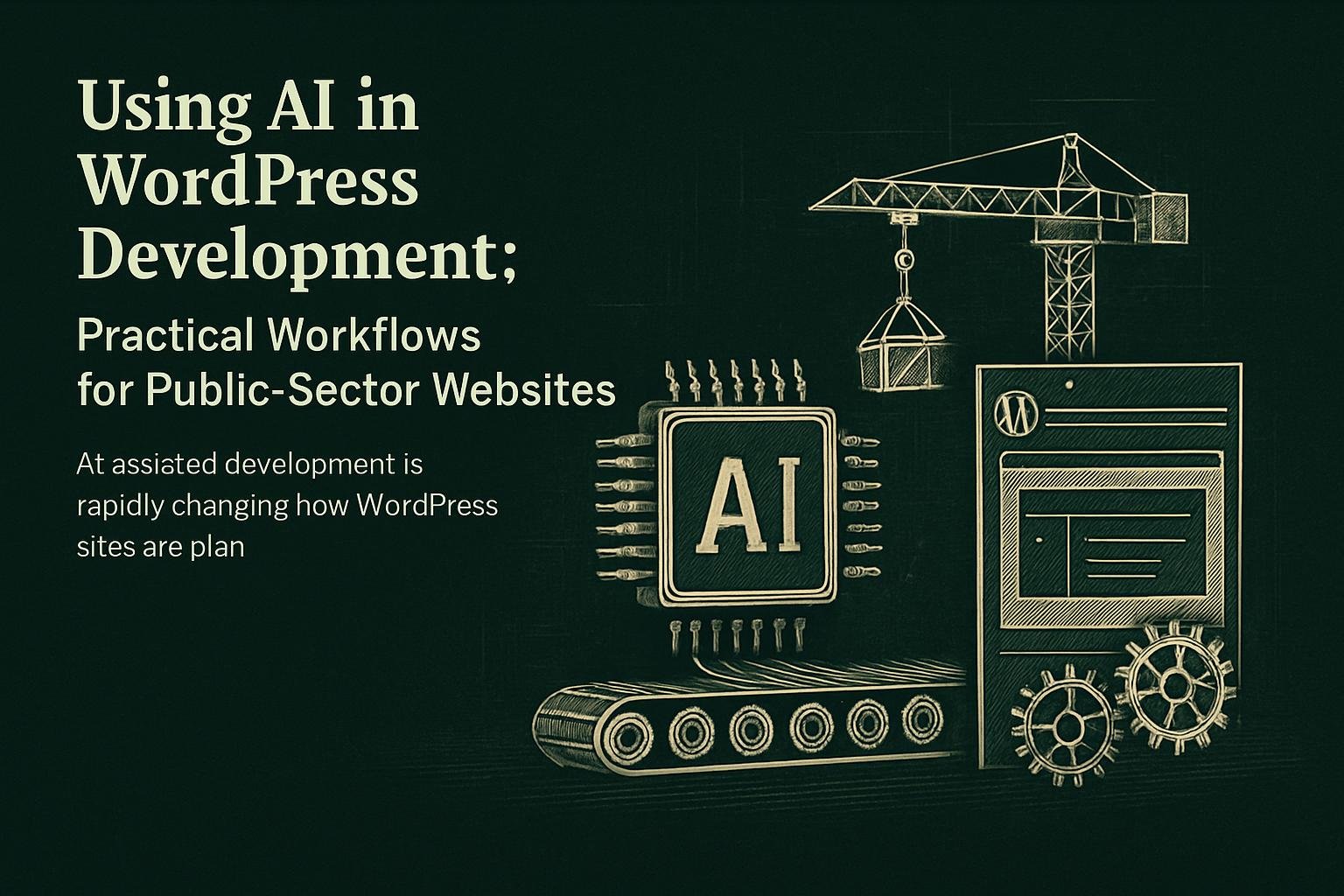
Using AI in WordPress Development: Practical Workflows for Public-Sector Websites
AI-assisted development is rapidly changing how WordPress sites are planned, built, and maintained. For public-sector digital teams, this shift is not just about speed—it is about making it easier to deliver accessible, reliable, and well-governed online services for residents, students, and staff.
This article explores how modern AI tools—similar to Claude Code and GitHub Copilot—are reshaping day-to-day WordPress workflows. It focuses on what “working alongside AI” can look like in a government, education, or community context, and how agencies can incorporate AI-enabled practices while protecting accessibility, security, and governance requirements.
Key Takeaways
- AI tools can significantly accelerate WordPress development while still supporting strict accessibility and security standards.
- “Human in the loop” review is essential for public-sector teams; AI should propose code and content, not deploy them autonomously.
- AI can help modernize legacy WordPress sites by suggesting refactors, accessibility fixes, and performance improvements.
- Public organizations can use AI to enhance content workflows, from plain-language rewriting to structured publishing and governance.
- Planning for AI belongs in procurement, digital strategy, and CMS governance—not as an afterthought.
What “Working Alongside AI” Means for Public-Sector WordPress Teams
In many commercial settings, developers now routinely use AI coding assistants and chat-based tools to draft functions, troubleshoot bugs, or scaffold new features. The same underlying capabilities can be thoughtfully aligned with the needs of state and local agencies, school districts, and community organizations.
In practice, “working alongside AI” in a public-sector WordPress environment often includes:
- Code suggestions in context: AI tools embedded in the code editor can propose PHP, JavaScript, and CSS snippets tailored to WordPress core functions, theme structures, and plugin APIs.
- Explaining legacy code: AI can summarize what older, undocumented code does, making it easier for new staff or vendors to understand inherited systems.
- Content assistance: AI can draft or refine content in plain language, help with reading-level adjustments, and suggest headings and structure for improved usability.
- Task automation: For routine updates or content transformations, AI can create scripts or workflows that reduce manual effort while preserving approvals and review steps.
The central shift is that AI becomes a colleague inside the development environment rather than a separate tool. However, for public entities, this collaboration must be governed by clear policies around privacy, security, and accessibility.
Modern AI-Enabled Tech Stack for WordPress
AI tools change quickly, but the structure of an AI-enabled WordPress stack remains relatively stable. Public-sector teams and their partners can:
1. Use AI Coding Assistants for Theme and Plugin Development
AI coding assistants can help:
- Generate boilerplate code for custom post types, taxonomies, and REST API endpoints.
- Integrate WordPress with external services (e.g., form submission APIs) while flagging potential security issues.
- Draft or refine block patterns and block variations for the Gutenberg editor.
This allows developers to focus on business rules, accessibility details, and agency-specific functionality instead of repetitive scaffolding.
2. Use AI Chat Tools as On-Demand Technical Reference
Instead of constantly switching between documentation, forums, and internal wikis, teams can:
- Ask AI to explain a WordPress hook or filter in plain language.
- Get step-by-step guidance on implementing features like custom roles, capabilities, or non-standard navigation structures.
- Generate examples that are then reviewed and adapted to the agency’s standards.
Done carefully, this reduces ramp-up time for new staff and helps small teams handle complex tasks without extensive trial and error.
3. Integrate AI into Content Operations, Not Just Code
Public-sector websites often manage large volumes of content across departments. AI can assist by:
- Suggesting consistent formatting, headings, and summaries for long policy pages.
- Helping convert PDFs or print-focused documents into web-native, accessible HTML content.
- Rewriting technical language into resident-friendly explanations while maintaining accuracy.
Here again, human reviewers retain control. AI acts as a drafting partner that accelerates work within established policies and review workflows.
AI and Accessibility in WordPress
For agencies and schools, accessibility is a legal and ethical requirement. AI can support accessibility work, but it cannot replace human testing and governance.
AI-Supported Accessibility Checks
With the right prompts and guardrails, AI can:
- Flag missing or unclear alt text and suggest accessible alternatives for images.
- Review markup patterns for potential issues with headings, lists, and landmarks.
- Propose ARIA attributes or skip-link patterns where appropriate.
These capabilities can accelerate remediation of existing content and guide new content creation, especially when paired with automated accessibility scanners and manual testing.
Maintaining Compliance and Trust
AI-generated code and content must still undergo:
- Accessibility review: Automated testing plus manual keyboard and screen-reader checks.
- Policy review: Alignment with language guidelines, privacy notices, and legal requirements.
- Security review: Code review, sanitization, and validation for all user input and output.
In other words, AI may draft, but humans approve. This is essential to maintaining trust and compliance in public-facing services.
Security, Governance, and AI-Enabled WordPress Workflows
Any AI adoption in a public-sector environment must align with security, privacy, and governance requirements. AI features should be evaluated just like any other component in a CMS ecosystem.
Security Considerations
- Code origin and review: AI-suggested code should be treated as untrusted until reviewed and tested, especially when dealing with authentication, data submission, or sensitive information.
- Data exposure: Teams need clear rules about what information can be shared with external AI services, particularly when handling protected or confidential data.
- Dependency management: AI should not be allowed to silently add new plugins or libraries without going through established change-control processes.
Governance and Content Oversight
AI use should be incorporated into content governance and CMS operating procedures:
- Clarify when AI can be used (e.g., drafting FAQs, summarizing program descriptions) and when it must not (e.g., legal notices, formal policies).
- Document AI-assisted changes and ensure they are traceable within version control or editorial logs.
- Provide training so content owners understand both the benefits and limitations of AI assistance.
This approach helps agencies gain the benefits of AI while keeping ownership, accountability, and institutional knowledge within the organization.
Future Directions: AI-Ready WordPress Plugins and Platforms
The WordPress ecosystem is already seeing plugins that embed AI into editing screens, search, and personalization. For public-sector teams, the focus is not on novelty, but on reliability and alignment with mission needs.
Potential AI-driven enhancements include:
- Accessibility recommendations in the editor: Real-time suggestions for headings, alt text, and contrast while content is being drafted.
- Structured content prompts: Editor sidebars that guide staff through required fields, reading-level checks, and metadata for governance.
- Improved search and discovery: AI-assisted search that helps residents find services even when they do not know official program names.
As these capabilities mature, agencies can evaluate AI-enabled plugins and configurations through existing procurement and security-review processes, rather than treating AI as an entirely separate category.
Practical Steps to Incorporate AI into Your WordPress Operations
Public-sector organizations do not need to adopt every new AI technology at once. Instead, they can pilot targeted, low-risk use cases that address current pain points.
- Start with internal-only use cases. For example, use AI coding assistants in development environments, or AI-based content drafting in staging sites, before activating any AI features in production.
- Define policies and guidelines. Establish what is allowed, what needs review, and what remains strictly manual, especially for legal and policy content.
- Train your teams. Provide practical training on how to prompt AI tools effectively, how to review outputs, and how to preserve accessibility and security requirements.
- Measure outcomes. Track whether AI is reducing turnaround time, improving content consistency, or simplifying accessibility remediation, and adjust usage accordingly.
- Plan for continuity. Ensure AI-enabled workflows are documented so that staff turnover or tool changes do not disrupt critical services.
Conclusion: AI as a Partner in Accessible, Governed WordPress Sites
AI tools are reshaping how WordPress sites are developed and maintained. For public-sector and community-serving organizations, the real opportunity lies in using AI to:
- Modernize legacy sites without sacrificing accessibility or security.
- Support small digital teams in handling complex WordPress tasks.
- Streamline content operations while strengthening governance and consistency.
With clear policies, human oversight, and a focus on accessibility and mission outcomes, AI can become a practical, sustainable partner in your CMS strategy rather than a trend to chase.
If your organization is exploring how AI-enabled workflows could support an accessible, resilient WordPress presence, you can learn more about our public-sector digital capabilities at https://izendestudioweb.com/government.
M Barton Productions LLC d/b/a Izende Studio Web provides digital-service capabilities to public and community-serving organizations. This article is informational and does not claim a completed government engagement.
Share this article:

Need Help With Your Website?
Explore website design, managed hosting, SEO, and practical digital support for your business.
Request a Quote